Stonework & Masonry — Muskoka & Georgian BayGranite country deserves real stonework.
Starting from — our real book rate
What stonework costs here
$48/ sq ft + HST
Typical project $9,600 – $19,200200–400 sq ft of natural flagstone walkway
05 specs37 photographs on file
Custom stonework in Collingwood, Blue Mountains & across cottage country
Sheet A-203 — The work
Stonework done properly
Walkways, steps, retaining walls, fire pits, and facing — natural stone that belongs in the landscape it sits in. Good masonry is preparation. On a recent 350 sq ft granite walkway we took the excavation to 14" — down to undisturbed soil — before a single stone went down, and sawed every joint, because granite won't chip clean the way limestone will. You'll never see the base. You'll notice it for thirty years.
Specification — Stonework
- A-203.01Granite and flagstone walkways, steps, patios, and landings — joints sawn, not chipped
- A-203.02Retaining walls engineered for frost and slope drainage
- A-203.03Fire pits and outdoor living features built to code
- A-203.04Stone facing and skirting for cottages and boathouses
- A-203.05Repairs and repointing of existing masonry
The question — What we're building in stone
What goes under it?
Granite is too hard to chip clean, so every joint is cut with a diamond blade. You will never see the base. You will notice it for thirty years.
Sheet A-203 — rates from the bookPer unit
Walkway or patio
$48/ sq ftExcavation, compacted base, stone and joints — all of it in the square-foot rate.
Granite slab steps
$850/ eaPer step, set into the grade they climb.
Armour stone wall
$325/ ftPer linear foot of wall, engineered for frost and slope drainage.
Dry-laid stone wall
$95/ sq ftPer square foot of wall face.
Facing and skirting
$75/ sq ftStone on cottages and boathouses, per square foot of face.
Fire pit
$3,850/ eaBuilt to code and placed to meet your township's setbacks.
Repair and repointing
$125/ hrExisting masonry, hourly.
Book rates, supplied and installed. Your written quote is measured from your site and shows HST as its own line.
Sheet A-203 — Process note
How stone goes down
The finished stone is the last ten percent of the work. On a recent 350-square-foot granite walkway we excavated 14 inches before we found undisturbed soil — the base goes to solid ground, not to a number on a drawing. Then compacted high-performance bedding in lifts, screeded flat, and each stone bedded and levelled by hand. Granite is too hard to chip clean the way softer flagstone chips, so every joint is cut with a diamond blade — tight, straight, and meant to be looked at. Edges get restrained so nothing walks, and water is directed away before the first stone is placed.
Materials we trust
Natural stone — granite where the landscape is granite. High-performance bedding aggregate for the base, compacted in lifts, because a walkway is only as good as what is under it. Polymeric sand or bonded jointing between stones, depending on joint width and traffic. Diamond blades for every granite cut; nothing else leaves a clean edge in stone this hard.
Sheet A-203 — Site conditions
Before we can put a number on it
Four things decide a stonework quote. We walk them with you on site — bring what you have and we'll find the rest.
Excavate, compact in lifts, screed flat — then stone. The finished stone is the last ten percent of the work.
- A-203.01The base
- We excavate to undisturbed soil, whatever depth that turns out to be. On a recent 350-square-foot granite walkway that meant 14 inches.
- A-203.02Water
- Where it runs now and where it should go. Frost doesn't lift stone — frozen water under stone lifts it.
- A-203.03Walls
- Once a wall gets up around a metre, holds back a driveway, or carries a slope above it, many municipalities want engineering. We tell you which side of that line your wall sits on before we quote it.
- A-203.04Fire
- Setbacks from structures and trees under your township's open-air burning by-law, and sometimes a permit to burn. Worth the call before you fall in love with a spot.
Record photographs — Stonework
Stonework we've built
Real projects photographed as jobs wrap up — towns named, clients never.
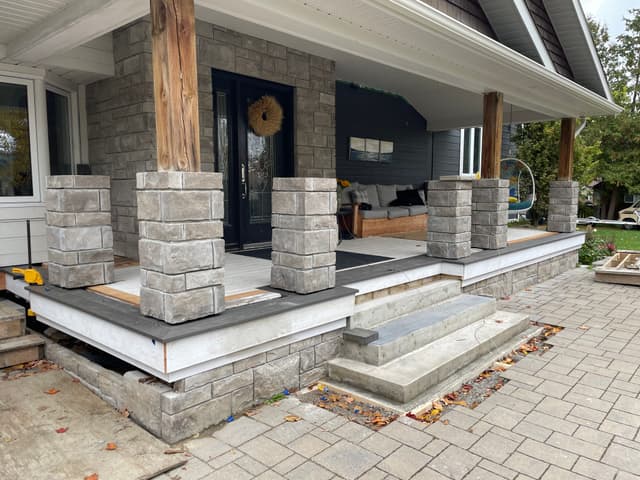
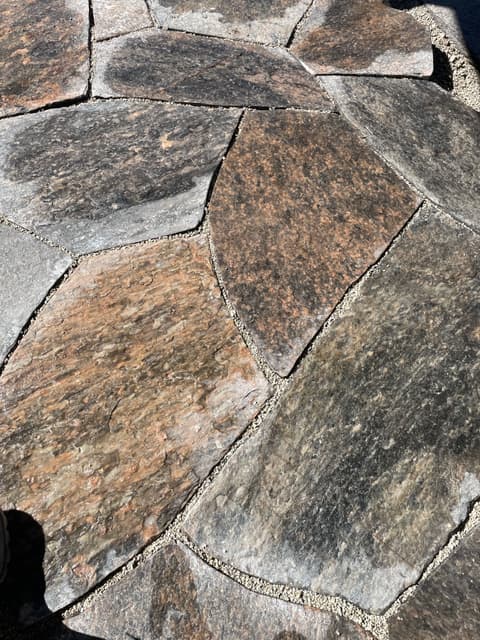
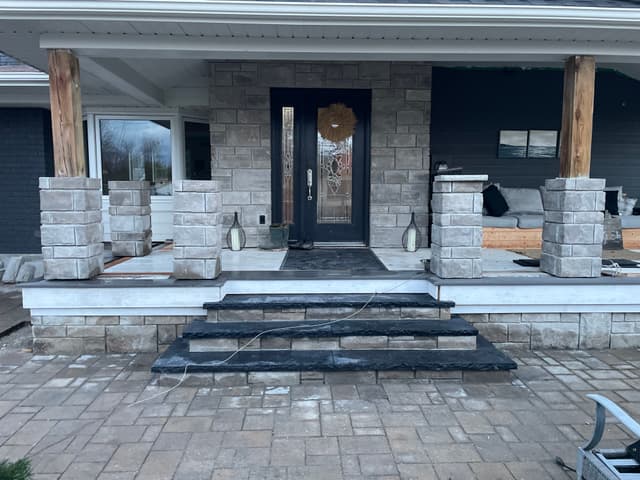
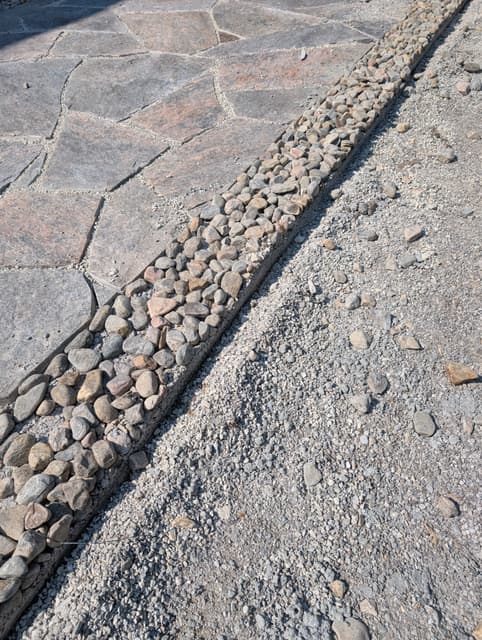
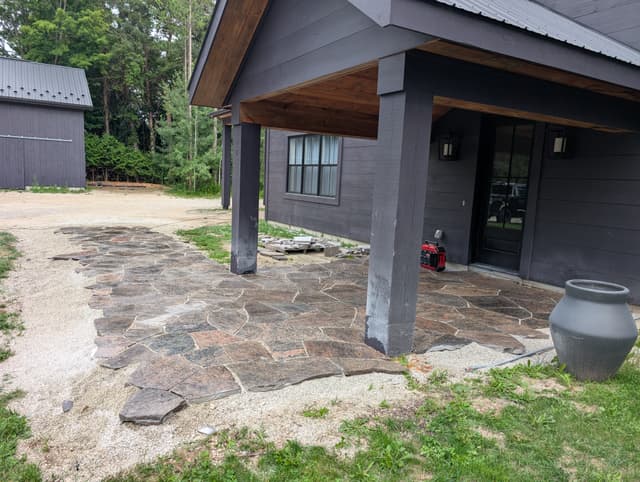
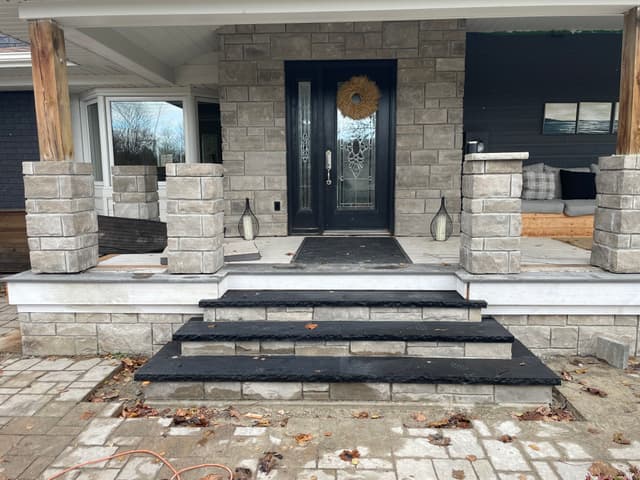
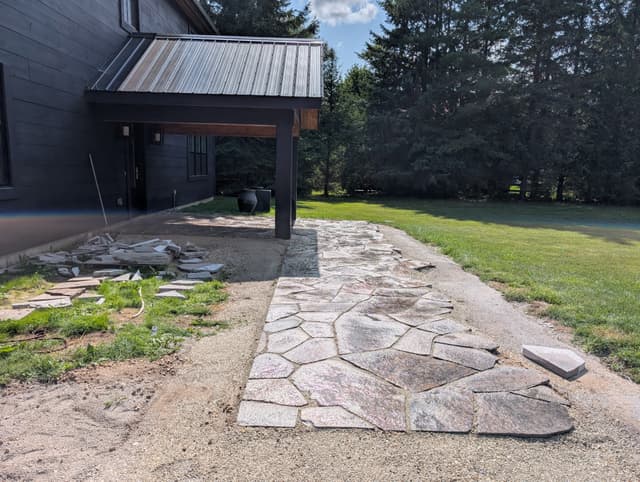
Hand-cut granite flagstone fitted tight, the narrow joints swept full with stone chip. — Collingwood, Ontario Stone-faced columns and porch wall with dark stone treads over the poured concrete steps. — Georgian Bay, Ontario Hand-fit granite flagstone with tight swept joints, edged by a band of washed river stone against the gravel drive. — Collingwood, Ontario Granite flagstone walkway finished from under the porch out to the drive, joints swept tight and the outside edge bedded into gravel. — Collingwood, Ontario Rock-faced stone veneer wrapping the porch piers and skirt, with dark stone treads set on the three entry steps. — Georgian Bay, Ontario Granite flagstone walkway laid on compacted screenings, running out from the covered entry. — Collingwood, Ontario
Sequence of work — 04 steps
Four steps, one point of contact
- 01Survey
Quote
We visit, measure, and send a written quote with HST shown — price honoured as quoted.
- 02Prep
Design & materials
We settle the layout together and price your material options side by side.
- 03Build
Build
One crew, a scheduled start date, and a tidy site every day we're on it.
- 04Finish
Walkthrough
We walk the finished work with you — it isn't done until you say it is.
We build stonework across Collingwood, Blue Mountains, Thornbury, Creemore, and Stayner — and everywhere north of Barrie. See our full service area.
Cost schedule — real book rates
What stonework costs here
Most stone walkways and patios we build land around $48 a square foot — excavation, compacted base, stone, and joints included. Granite slab steps are $850 a step. Armour stone retaining walls run $325 a linear foot; dry-laid natural stone walls are $95 a square foot, and stone facing or skirting is $75. A code-compliant natural stone fire pit is $3,850, and masonry repair runs $125 an hour. These are our real book rates. Your written quote is measured from your site and shows HST as its own line.
Straight answers
Questions we get about stonework
What's actually under the stone?
Solid ground, or we keep digging. On a recent 350-square-foot walkway that meant excavating 14 inches down to undisturbed soil. Then high-performance bedding aggregate, compacted in lifts and screeded flat. Most failed walkways we are asked to fix failed underneath, not on top — the stone was fine; the base was hopeful.
Why saw the joints instead of chipping them?
Because granite won't chip clean. Softer stone can be dressed with a hammer; granite fractures where it pleases. So we cut every joint with specialty diamond blades. It is slower and it eats blades, but the joints come out tight and straight and they stay that way.
Will it heave in the winter?
Not if the water has somewhere to go. Frost doesn't lift stone — frozen water under stone lifts it. Excavation to undisturbed soil, a free-draining base, and edge restraint deal with the water before it can freeze into a problem. That is the whole game in this climate.
Do retaining walls need an engineer?
Sometimes. Low garden walls generally don't. Once a wall gets up around a metre, holds back a driveway, or carries a slope above it, many municipalities want engineering — and honestly, so do we. We will tell you which side of that line your wall sits on before we quote it.
Can I have a fire pit at the cottage?
In most townships, yes, within the open-air burning by-law — setbacks from structures and trees, and sometimes a permit to burn. We build the pit itself to code and place it to meet your township's rules. Worth a call before you fall in love with a spot; we make that call with you.
Sheet A-500 — Request for quote
Get a number you can hold us to.
No obligation. A written quote with HST shown — price honoured as quoted.